Showing posts with label soil science. Show all posts

Saturday, 26 July 2014

Sorting litter at home and abroad

Since I finished volunteering on the BESS Earthworm Project I have been continuing to work in the Natural History Museum Soil Biodiversity Group sorting leaf litter samples on my day off. After the sieved leaf litter samples have spent three days in the Winkler bags the pots are removed and the alcohol containing the invertebrates (and hopefully not too much mud and debris!) is decanted into tubes ready to be sorted by volunteers. Each litter sample is poured into a petri dish and put under the microscope for sorting. If you are lucky the sample looks like this; a nice clean sample with not too much debris where the the invertebrates can easily be picked out and counted.

A nice clean Soil Biodiversity Group litter sample
A nice clean leaf litter sample ready for sorting

However sometimes the samples look like this! This one I had to split into parts and dilute in order be able to pick out the specimens from the murky alcohol. The invertebrates are identified to order level and each group counted into its own glass tubes which are labelled with the sample details and bundled together, some will eventually go on for species identification, and in the case of some tropical samples, DNA sequencing.

'Dirty' leaf litter sample - the stuff of volunteers' nightmares!A soil group volunteers’ nightmare!

I started off sorting litter samples from Borneo, these are from one of my many projects run at Stability of Altered Forest Ecosystems (SAFE). This site provides a gradient of forest modification, from primary rainforest to increasing levels of logging and fragmentation, and finally oil palm plantation. I was excited to work with tropical samples for the first time although I did not find them as different from UK leaf litter samples as I expected. Many of the groups were familiar, within the beetles there were Staphylinidae which I recognised as from subfamilies Pselaphinae and Aleocharinae; but every so often though I was reminded that I was ‘abroad’ when a sample turned up exotic invertebrates such as termites, scorpions and crickets.

Soldier termites in a Soil Biodiversity Group leaf sample from Borneo
Meeting soldier termites for the first time in a Soil Biodiversity Group leaf sample from Borneo

I also noticed that when samples had a lot of ants or termites they had very few other invertebrates, which was a striking illustration of how much impact these two groups have on tropical forest ecosystems. Sometimes the number of ants or termites in the samples can be very high indeed, this tube from one litter sample has over 200 individuals. A current joint project with the Soil Biodiversity Group and Kate Parr’s lab is investigating how termites and ants effect other soil and litter invertebrates by excluding them experimental plots. 
A tube of termites sorted from a Soil Biodiversity Group litter sample
Hundreds of termites sorted from a Soil Biodiversity Group litter sample

Some of my favourite invertebrates from the Borneo samples were these cute little scorpions and a fly with beautiful wing patterns. I am now back to sorting samples from the UK as we process those from the National Vegetation Classification project, which have a pleasing familiarity to my MSc leaf litter samples. Each sample has a different ‘character’ however so I never get bored, sorting Winkler samples to me as exciting as opening my stocking on Christmas morning – the old favourites are always there but you also never know what exciting new things there will be!
Scorpions and a pretty fly from Borneo leaf litter samples


Monday, 21 July 2014

A day in the woods with the Soil Biodiversity Group

I recently took a day off volunteer on fieldwork with the Natural History Museum Soil Biodiversity Group – my first fieldwork with the group since the BESS Earthworm Project, and a nice change from the pollinator and plant surveys I have been doing as part of my work at Reading University. The project I assisted on this time is the National Vegetation Classification (NVC) Project, this is a structured survey of soil and litter invertebrates across UK woodland types which began in 2002 and is now on its third round of sampling. The National Vegetation Classification categorises all UK ecosystems according to major vegetation type (woodland, grasslands etc.) which are then broken down into community types according to plant species composition. Woodlands are given the prefix W and fall into ‘wet woodland’ W1 to W7 and ‘dry woodland’ W8 to W18, this year is the turn of the dry woodlands and the study site I visited was Warburg Nature Reserve in Oxfordshire, an example of W12, a beech (Fagus sylvatica) woodland with plants characteristic of basic soils such as Dog’s Mercury (Mercurialis perennis).

2014-07-01 11.07.14 Quadrat assembled – sampling can begin!

Instead of sampling from random quadrats as in my MSc fieldwork the NVC project uses a transect through the habitat with a 1m square quadrat being sampled at set intervals, alternating each side of the transect line. Other than that the method was similar, fellow volunteer and current MSc student Dan and I took turns scrapping and sieving litter from the quadrat which was then bagged up with a label to take back to the lab. Paul took the environmental readings while Kelly dug a soil pit and collected any invertebrates found into tubes of alcohol. A vegetation survey was also made of each quadrant, although being a beech woodland this was sparse and a lot less effort than my MSc project were the quadrats were often covered in vegetation!

2014-07-01 12.31.39

Dan sieves leaf litter while Kelly sorts soil for invertebrates

After the cold wet days sampling in the middle of winter for the BESS Earthworm work the NVC fieldwork on a sunny day was quite a treat, finishing before lunch! Then it was back off to the Natural History Museum to process the leaf litter samples. The sieved leaf litter is placed into mesh bags which are hung inside a Winkler bag, basically a cloth funnel with a pot of alcohol tied to the bottom. These are hung up for three days and as the leaf litter dries the invertebrates move downwards into the pot where they are preserved ready for sorting and identification. Once, the Winkler bags were hung up in one of the towers either side of the main entrance of the Museum, but now they are in a much more convenient location which doesn’t involve carrying bags of leaf litter up narrow Victorian staircases!

Dr Paul Eggleton putting leaf litter samples into Winkler bags

Paul puts the sieved leaf litter samples into Winkler bags

After the three days are up the pots can be removed ready to be sorted and counted to order level by volunteers with selected invertebrate groups later identified to species level. The NVC dataset is just one example of long-term data collection by the NHM Soil Biodiversity Group, another being the monthly sampling at Whitley Wood in the New Forest, which I am volunteering on in August. I am very excited to be given the opportunity to analyse these datasets, among others, in my upcoming PhD.

Wednesday, 25 June 2014

A royally good earthworm meeting

A couple of weekends a go I attended a meeting organised by the Earthworm Society of Britain (ESB), this two day event consisted of a field trip to Richmond Park on the Saturday followed by a workshop on the Sunday to identify the specimens collected on the trip. Unfortunately I could only attend one day, and because Richmond Park was high on my ‘places to visit’ list and I have had no shortage of earthworm identification lately I decided to attend the Saturday event.

Richmond Park is one of the Royal Parks and the largest enclosed space in London, it is a National Nature Reserve, Site of Special Scientific Interest (SSSI) and a European Special Area of Conservation (SAC), because of this the ESB had to obtain special permission and a permit to collect earthworms. It was one of those glorious English Summer days when you can get soaked and sun-burnt in the same day! A group of 10 earthworm fans assembled at Richmond Station, clad in waterproofs before taking a bus to the park – my first ever trip on a London Bus – so that’s another ‘things to do in London’ crossed of my list! I had barely stepped into the Park when I got stuck in grubbing about in a rotten tree, finding the first earthworm off the day – and it was adult, so into a tube it went ready for Sunday, when it turned out to be Eisenia fetida.

Earthworm Society of Britain (ESB) members huddle in the rain at Richmond Park
Earthworm Society of Britain (ESB) members huddle in the rain around the first earthworm of the day at Richmond Park

The organisers had planned a range of areas to visit in the Park, aiming to visit as many habitats as possible to maximise the number of species recorded, and to cover as many grid squares as possible to increase the number of earthworm records. The first stop was some quite acidic looking grassland, where Kieron gave a crash course in earthworm surveying for those who had not done it before and introduced the ESB method and recording forms. As might be expected from the soil type, this area yielded few earthworms but other areas of neutral, improved grassland were better. We also surveyed woodland areas which again appeared to have an acid character, with lots of Rhododendron ponticum and was earthworm-poor.

Earthworm Society of Britain members survey for earthworms in grassland in Richmond Park

The best areas in terms of numbers were two wet habitats, one a small stream where we dug pits along the bank and took material from the bed itself, and a fen area. The stream produced a very special earthworm indeed: Helodrilus oculatus – an earthworm with very few records, all previously from wet deciduous woodland. This was an earthworm I was particularly keen to find, although I feel I can only half cross it off the ‘earthworm bucket-list’ since I did not see it under the microscope. Wet habitats are unrecorded for earthworms, and can have specialist semi-aquatic species, something I discovered when I targeted seeps in my MSc project and found lots of Eiseniella tetraedra which also turned up in some number in the Richmond Park fen habitat.

Ditch in Richmond Park where Helodrilus oculatus was found
The small stream in Richmond Park where Helodrilus oculatus was found 

Concentrating as we were on earthworms I did not have much time to admire Richmond’s other charms and will have to make a point of visiting again when I am living back in London. We did however see some of the deer, including a mother and fawn, and saw the spot where this (in?)famous video was filmed. A visit to see the rut in the Autumn is high on my ‘things to do in London’ list!

Earthworm Society of Britain members admiring deer in Richmond Park
Earthworm Society of Britain members admiring a camera-shy deer in Richmond Park 

Towards the end of the day Keiron gave a demonstration of how to relax and straighten earthworms using a plastic storage box. Putting the earthworms straight into a 80% solution of alcohol (industrial methylated spirits or IMS in this case) is a quick way to sample but causes them to twist and curl which can make them more difficult to identify. By first using a 30% alcohol solution to anaesthetise them they can be arranged in the groves of a plastic storage box (or I use drinking straws cut in half lengthwise). This helps make a nice neat reference collection, but I find it takes too much time if a lot of sites are being sampled.

Kieron demonstrates how to relax and straigten earthworms for easier identificationKeiron demonstrates how to relax and straighten earthworms for easier identification

There was time to end the trip with a pint in a local pub before heading back to the station. The workshop the next day revealed a total of 15 species from the 7 sites were collected, all adding to the ESB data set. It is interesting to note this is the same number of species from the entire BESS project, which only sampled pasture, illustrating how sampling from a wide range of habitats can make a big difference to the number of species found. Reading the report recently circulated to members, in addition to the Helodrilus oculatus I also missed out on meeting Dendrobaena octaedra and Apporectodea icterica under the microscope for the first time! Looks like I will have to try and diversify the habitats I do my own sampling in.

The next Earthworm Society of Britain meeting is planned for the Autumn – why not join in? Membership is only £5 a year and on completion of the workshop you are given a recording pack which includes a copy of the AIDGAP Key to Earthworms.


Friday, 28 February 2014

Return of the worm

I kept going back to that Lumbricus sp. that I was stuck on after my last garden earthworm foray, and after segment counting over and over it still kept coming out as L. festivus, an uncommon species. With some trepidation (not least because I had just volunteered to help with earthworm identification) I brought it into the Soil Biodiversity Group laboratory at the Natural History Museum for Dr David Jones to check. To my delight and relief my identification was correct bringing my garden earthworm species list to nine.
 
Lumbricus festivus
The (half of) Lumbricus festivus I found in the garden

As mentioned, since I now have a wage and days off during the week I have been able to return to volunteer with the Soil Biodiversity Group helping to sort and identify the earthworms sampled on the NERC BESS project. With my Christmas money I bought my own copy of Sims and Gerald and am learning more advanced skills in earthworm identification, with David pointing out features and giving tips on identification when the key cannot be used, like the headless Octolasion cyaneum in the first sample I looked at.
 
Sorting and identifying NERC BESS earthworm samples

I like to start by picking out all the immature worms, for the most part these cannot be identified to species but they can be assigned to an ecotype which can still be analysed, for example any pale coloured immature earthworms are the soil feeding endogenic type. Next I move on to the damaged worms, which can be a bit of a ‘worm jigsaw’, sometimes it is possible to identify them to species if enough features are still present. Then it is on to species level identification, so far I have identified eight species from two of the fields at the Aberdeen site. The most frequent species was Aporrectodea caliginosa; I have identified 162 in ‘my’ two fields so it is exciting when something else turns up!
 
Yet more Aporrectodea caliginosa

I have also ‘met’ some species under the microscope for the first time, including the UK’s biggest earthworm species – Lumbricus terrestris, and at the opposite end of the scale the little L. castaneus. I will be in once a week identifying earthworms and looking forward to meeting more species as the samples go on.

Lumbricus terrestris awaits inspection under the microscope


Sunday, 5 January 2014

Garden earthworm bothering part 2: identification


So how do you go about identifying an earthworm? Firstly in most cases your earthworm needs to be an adult, mature earthworms have a saddle (clitellum) which is part of the reproductive system – forming a cocoon which protects the earthworm’s eggs. Unfortunately only five of the earthworms collected from my garden survey were adults so the rest went back into the garden unidentified.

Lumbricus sp.

There are 27 species of earthworm in the UK, some of which, like the Eisenia fetida I found in the compost heap, can be identified in the field, for these you can use the free OPAL Earthworm Guide or online key but others require close examination using a microscope and an identification key. The ‘bible’ for UK earthworm identification is Sims and Gerard (1999) but as Father Christmas was not kind enough to bring me a copy I used Sherlock (2012). This key is published by the Field Studies Council and is part of their excellent AIDGAP (Aid to Identification in Difficult Groups of Animals and Plants) series, it is a perfect step up from the OPAL guide and I highly recommend it - if you join the Earthworm Society of Britain you will receive a copy in their recording pack.

worm3
Earthworm underside showing some features used in earthworm identification

By now I have seen a fair few earthworms so I was reasonably confident without using a key that my two from the soil pits were in the genus Lumbricus, these tend to be dark in colour and often iridescent, but it is good practice to check. In the FSC key Lumbricus and one other genus are separated in the first couplet by the structure of their head. At the head of the worm is a fleshly lobe or prostomium which covers the mouth, in some worms two lines run from the prostomium so from the top it looks like the first segment is split into three, this is known as a tanylobic head and is the type found in Lumbricus (the other type is called epilobic).

Top view of Lumbricus head and clitellum showing iridescence
Top view of earthworm head and clitellum (note the iridescence)

The next step is to count the number of segments before the clitellum and how many segments the clitellum covers. This can be quite tricky and I find it particularly difficult on the clitellum were the segments are not as distinct. Unfortunately this was the case with my two specimens so for now I will have to leave them at Lumbricus sp. until an expert at the museum can help me with them, such is the way with identification, especially when you are learning, but with my perfectionist nature I still find this hard to deal with.

Thankfully my confidence was restored by being able to identify the two species I found underneath my log pile, these were both epilobic worms.

Aporrectodea caliginosa showing epilobic type head

Other characters used in earthworm identification are the position and shape of the tubercula pubertatis (TP for short) which are a pair of raised pads on the side of the clitellum, both my worms from the log pile had distinctively shaped TPs which I recognised from earthworms identified during my MSc project. The larger pale specimen had two bumps on segments 31 and 33 so I recognised it as Aporrectodea caliginosa, one of the most common UK earthworms. The bumps can sometimes be so prominent they can be seen without a microscope.

The distinctive two bumps on the TP of Aporrectodea caliginosa
The distinctive two bumps forming the TP of Aporrectodea caliginosa

The other two worms were much smaller and dark red in colour with a crescent shaped bump on the TP which I recognised as belonging to Satchellius mammalis, the 5th commonest species I found in my MSc study site.

Satchellius mammalis
The crescent-shaped bump on the TP of Satchellius mammalis

So with just an hour in the garden and I already have 4 or 5 earthworm species ready to submit to the Earthworm Recording Scheme. Why not have a go yourself? For such an ecological important group earthworms are terribly under-recorded and with just a small number of species with good identification keys and reasonably clear identification features they are a nice group to 'do'.

Wednesday, 1 January 2014

Garden earthworm bothering part 1: sampling


I have sulking at home since the Soil Biodiversity Group earthworm fieldwork ended so between Christmas and the New Year I decided to get out into the garden and hunt for earthworms - one of the great things about earthworms is that they are active even during winter so long as the ground is not frozen. There was some difficulty in that my sister had borrowed the spade so I had to make do with a fork and trowel, not ideal for making neat soil pits. Also, my ‘assistant’ who was curious to what I had been up to in fields these past weeks turned up without his warm clothes and waterproofs so it ended up being a rather brief survey which I will continue in the New Year.

Image00001
Andrew, my somewhat reluctant ‘assistant’ Quote: “You did this all day in a field!? Would drive me round the bend”

Garden earthworm survey - pouring the mustard solution
But despite this I did let him pour the mustard solution

I used the standard method for earthworm surveys, details of which can be found on the Earthworm Society of Britain website. The first pit was dug in the scruffy bit of grass that passes for a lawn and I was surprised to find the soil was drier, less clayey and less compacted than I expected. It was also without structure, no layers of top soil and subsoil like I have been used to in the fields and woodland, just loose soil on top a layer of rubble – sadly typical of suburban soils - but there were still earthworms. Sadly the mustard solution did not produce any earthworms although I was not surprised as the soil is rather shallow and I have not seen many of the distinctive casts the anecic types make.

An earthworm in its burrow
An earthworm in its burrow in the soil removed from the lawn

Sadly the mustard solution did not produce any anecic earthworms although I was not surprised as the soil is rather shallow and I have not seen many of the distinctive casts they make on the lawn.The next pit was made in one of the raised vegetable beds and even this highly disturbed area produced five earthworms, although unfortunately all immature specimens which could not be identified to species. As we were losing daylight and Andrew was getting cold we had a quick look in some microhabitats rather than start another soil pit. As expected the compost heap produced lots of the Compost or Brandling Worm Eisenia fetida which lives in areas of high organic matter, it has a stripy appearance when moving and they exuded a unpleasant yellow fluid when handled.

Compost worm Eisenia fetida
A handful of Eisenia fetida

Under my log pile I found two small red worms and a larger pale pink one which along with the two adult earthworms from the soils pits were retained for identification. In part two I will go through the steps in identifying these earthworms.

Friday, 20 December 2013

Earthworms – the final chapter!


With the soil analysis laboratory in York shortly closing for Christmas the race was on to complete enough samples in each field and county for the statistician on the project to work his magic. The result was an epic 400 mile round trip to finish off sampling fields in Leicestershire, Berkshire and Dorset. It was just David and I who set off Sunday evening for Leicester, meaning that I was navigator (oh the pressure!), but on Monday we met up with Jo who is the technician at the University of York undertaking the soil analysis, to finish the final field in Loddington.

Dr David Jones and Jo sorting soil in Loddington, Leicestershire

Jo and David sorting soil (is David praying for the project to end?)

It was great to meet with Jo and find out about the soil analysis side of the project, at the moment she is working on the samples taken for the measurement of microbial activity since these need to be processed quickly for accurate results, later analysis will be done on particle size, pH, nutrient content and more. The method used by the lab is the fluorescein-diacetate (FDA) hydrolysis assay, enzyme activity from microbes in the soil sample cause the colourless FDA to break down into fluorescein which is a fluorescent yellow-green. The intensity of the colour is measured using spectroscopy and comparison with a standard determines the relative microbial activity of the sample.

Not unlike the earthworms Jo has found the microbial activity to vary greatly both between and within fields, from extremely high in the field in Yorkshire with the longhorn cattle to nearly ‘dead’ in one of the fields in Berkshire. Jo informed me that clayey soils are particularly difficult to process which I could sympathise with as they are also difficult to sort!

We made good progress despite being just the three of us, squeezing in an extra 11th sample which unfortunately had to be sorted in car headlights (again) and I made the tactical error of not taking my waterproofs off so ended up being volunteered to wander around a field in the dark to put the soil back in the hole.

Dr David Jones and Jo sorting soil in car headlights in Loddington, Leicestershire

Such dedication!

Loddington finished, Jo returned to York with the soil samples and David and I travelled south to Berkshire, returning to the lovely Dundas Arms, sadly too late for dinner but they did make us some amazing sandwiches. In the morning we were joined by Paul and Kelly and volunteers Cecilia and Alex, as a team of six we made brilliant progress and a super 21 samples were completed.

Kelly, David and Cecilia sampling earthworms in Berkshire

Kelly and David take the environmental variables while Cecilia prepares to sort
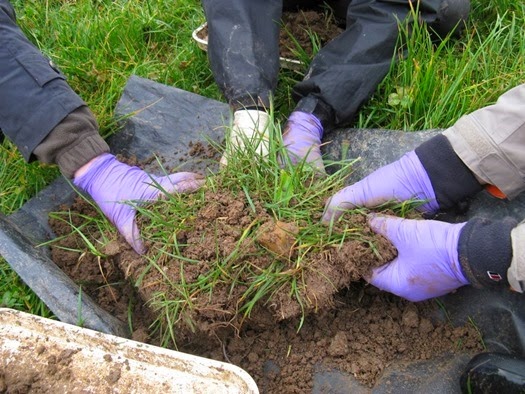
The Soil Biodiversity Group gets stuck into sorting another sample

The Soil Biodiversity Group gets stuck into sorting another sample

With still a few left to do in Berkshire next week the rest of the team went their separate ways while David and I travelled to Dorset. Thankfully this time we arrived in time for a pub dinner, nothing like two days of sandwiches for dinner to make me appreciate a hot meal! The next morning we met with the farmer of the final farm to find out about the management history of the fields and decide which would be suitable for the project. After picking up Paul from the train station we began sampling the penultimate field of the project.
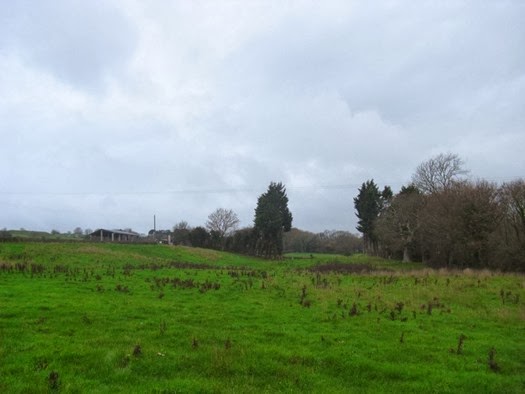
The penultimate field in the earthworm project

The penultimate field, the barn at the back would prove useful later in the week!

On Thursday we were joined by fellow project veterans Sholto and Irfaan to finish off the field in the quarry (no blasting this week sadly) and the other two fields. By Friday the weather was against us, but we maximised the work achieved by sorting in the barn during the heaviest rain and by dusk the required samples had been done!
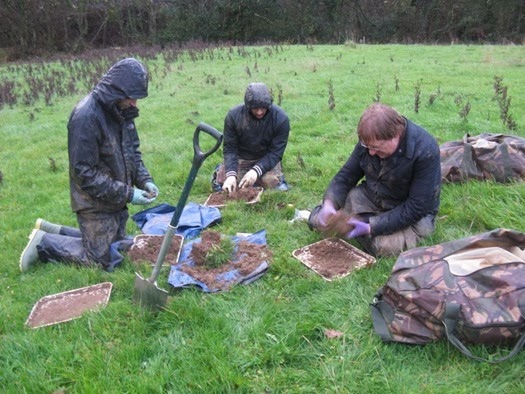
A wet and muddy Soil Biodiversity Group in the rain in Dorset

A very wet and muddy Sholto, Irfaan and Paul sorting in the rain in Dorset

All that remained was to finish the two fields in Berkshire so on Monday David, Paul and I met up again for the final day of sampling, two weeks and a day overdue! The fields were extremely wet, particularly (and not surprisingly) the one by the river, with one soil moisture reading at 100%. In the absence of a tap the stream proved useful for filling the mustard bottles, since they were to be used straight away the issue of bacterial contamination was avoided.

Dr David Jones makes up mustard solution

In the absence of a hotel or research centre to fill the mustard bottles, a stream will do


And now…

The final pit

And so finally the time had come, after 10 weeks of field work, the final pit was dug!

The final pit of the project

At last – the final pit!

Image00009

And Paul had the ‘honour’ of pouring the final bottle of mustard solution

Of course the project is not over, there are still thousands of earthworms to count and identify, soil samples to analyse, numbers to crunch, meetings to attend and papers to write, but my part is done. It has been a fantastic experience for me to be part of such an ambitious project. Being involved has given me a greater understanding of what is involved in research,  including the logistical and political aspects as well as the science. I have been reminded how much I enjoy field work, even in the rain and mud but most of all I reaffirmed my aspiration to be a researcher. I miss being in a muddy field but most of all I miss the interaction with like-minded people (wow, never thought I would say that!) – from discussion on scientific topics to intense debate on the merits of different biscuits. The New Year should bring more financial stability after my student life and so I hope to be able to visit the Museum once a week and continue volunteering with the Soil Biodiversity Group.

And so I offer a big thank you to everyone I worked with on the project, you have been an inspiration.

Saturday, 30 November 2013

More earthworm bothering


For eight days in November I returned for more earthworm survey work with the Natural History Museum Soil Biodiversity Group, this time in Somerset and Berkshire. A small team of volunteers this time, just myself and long-time SBG volunteer Irfaan, travelled first to the Somerset site to continue work started the previous week. We had been informed the Somerset site was the most beautiful yet but when we arrived on Monday the fog was so thick we had to take David’s word for it! Thankfully, by Tuesday the sun had returned to reveal a superb landscape, the countryside you imagine from hundreds of years ago, with little patchwork fields fringed with ancient hedgerows.

Somerset survey site in the fog

Somerset survey site in the sun
What a difference a day makes in Somerset

Four fields are sampled per farm, covering a spectrum of management intensity, such as how often the field is grazed, how much fertiliser (animal or artificial) is added and whether it has been ploughed or used for crops in the past. The field we worked first was the lowest intensity field at the Somerset site, not surprisingly as it was some distance from the nearest track, was steep and had springs running through it. This field had never been ploughed, giving an odd feeling of being possibly the first people to disturb the soil. It also had the biggest Yellow Meadow Ant (Lasius flavus) mounds I have ever seen!

Huge Yellow Meadow Ant (Lasius flavus) mound in Somerset
Horse battered Yellow Meadow Ant (Lasius flavus) mound, at least two foot tall

Dr David Jones digging an earthworm pit in Somerset Dr David Jones taking a bulk density core soil sample in Somerset
Digging and coring in Somerset, quite possibly the first time the soil has been broken by man!

For a change from sheep and cows the fields at the Somerset site were grazed by Shire Horses which noised around us and the kit expecting food and generally being a distraction, having to be chased away at intervals. As handsome as the Shires were, I was more excited and distracted by the lovely Noon Flies (Mesembrina meridiana).

Shire Horses in Somerset

Dipterological distraction: Noon Fly (Mesembrina meridiana) in Somerset
Dipterological distraction: Noon Fly (Mesembrina meridiana) in Somerset (thanks to Georgie for this photograph from the previous week's visit)

Within each field a bare minimum of 18, preferably 20, samples are made. Half of these are located at random using a combination of a randomly chosen direction and distance. The direction is decided using a super scientific method of David spinning around.

Finding a random direction for the next sample site
If he had fallen over I could have bagged £300 pounds!

It is double blind so that some else who is not watching calls out when to stop, although this sometimes has to be done a couple of times if the random direction is in an unsuitable place, such as too close to the edge of the field or trees which may have different micro-environment to the rest of the field. The distance from the previous pit to the next is then determined by a random number table. The rest of the samples are coverage pits which are spread out over the field.

Once the location is marked with a flag it’s time to start over again taking measurements, digging a pit, taking samples and hunting for worms!

Natural History Museum Soil Biodiversity Group volunteers Irfaan and Victoria sorting soil for earthworms in Somerset
Irfaan and I intently sorting soil for worms

Earthworm
There’s one!

On this trip we came across one of my favourite species of earthworm, the Blue-grey worm (Octolasion cyaneum), this is the UK’s largest species of pale earthworm and is often a pretty bluish colour, with a yellow tail, but we did not get many of the big anecic earthworms that emerge after the mustard solution is added.

Blue-grey worm (Octolasion cyaneum)

On Thursday we left Somerset for Berkshire, unfortunately still with a field left to finish. The site in Berkshire was the Organic Research Centre Elm Farm.

Organic Research Centre Elm Farm

Excitingly the very first pit had a bumper crop of the UK’s largest earthworm - Lumbricus terrestris emerge when the mustard solution was added, some were bigger than by baby snakes at home! Could this be because of higher organic inputs in this field than Somerset? The statistics will tell us in time (hopefully!).

Lumbricus terrestris expelled by mustard solution

Oh and yes the mustard solution is often made up in our hotel rooms, if your next stay has a whiff of Colman’s, maybe the SBG have been there!

Hotel mustard solution station