Showing posts with label entomology. Show all posts

Saturday, 26 July 2014

Sorting litter at home and abroad

Since I finished volunteering on the BESS Earthworm Project I have been continuing to work in the Natural History Museum Soil Biodiversity Group sorting leaf litter samples on my day off. After the sieved leaf litter samples have spent three days in the Winkler bags the pots are removed and the alcohol containing the invertebrates (and hopefully not too much mud and debris!) is decanted into tubes ready to be sorted by volunteers. Each litter sample is poured into a petri dish and put under the microscope for sorting. If you are lucky the sample looks like this; a nice clean sample with not too much debris where the the invertebrates can easily be picked out and counted.

A nice clean Soil Biodiversity Group litter sample
A nice clean leaf litter sample ready for sorting

However sometimes the samples look like this! This one I had to split into parts and dilute in order be able to pick out the specimens from the murky alcohol. The invertebrates are identified to order level and each group counted into its own glass tubes which are labelled with the sample details and bundled together, some will eventually go on for species identification, and in the case of some tropical samples, DNA sequencing.

'Dirty' leaf litter sample - the stuff of volunteers' nightmares!A soil group volunteers’ nightmare!

I started off sorting litter samples from Borneo, these are from one of my many projects run at Stability of Altered Forest Ecosystems (SAFE). This site provides a gradient of forest modification, from primary rainforest to increasing levels of logging and fragmentation, and finally oil palm plantation. I was excited to work with tropical samples for the first time although I did not find them as different from UK leaf litter samples as I expected. Many of the groups were familiar, within the beetles there were Staphylinidae which I recognised as from subfamilies Pselaphinae and Aleocharinae; but every so often though I was reminded that I was ‘abroad’ when a sample turned up exotic invertebrates such as termites, scorpions and crickets.

Soldier termites in a Soil Biodiversity Group leaf sample from Borneo
Meeting soldier termites for the first time in a Soil Biodiversity Group leaf sample from Borneo

I also noticed that when samples had a lot of ants or termites they had very few other invertebrates, which was a striking illustration of how much impact these two groups have on tropical forest ecosystems. Sometimes the number of ants or termites in the samples can be very high indeed, this tube from one litter sample has over 200 individuals. A current joint project with the Soil Biodiversity Group and Kate Parr’s lab is investigating how termites and ants effect other soil and litter invertebrates by excluding them experimental plots. 
A tube of termites sorted from a Soil Biodiversity Group litter sample
Hundreds of termites sorted from a Soil Biodiversity Group litter sample

Some of my favourite invertebrates from the Borneo samples were these cute little scorpions and a fly with beautiful wing patterns. I am now back to sorting samples from the UK as we process those from the National Vegetation Classification project, which have a pleasing familiarity to my MSc leaf litter samples. Each sample has a different ‘character’ however so I never get bored, sorting Winkler samples to me as exciting as opening my stocking on Christmas morning – the old favourites are always there but you also never know what exciting new things there will be!
Scorpions and a pretty fly from Borneo leaf litter samples


Monday, 7 July 2014

Celebrating 50 Years of the Biological Records Centre


Last weekend I was at a symposium in Bath celebrating 50 years of the Biological Records Centre (BRC). The BRC collates and manages species observation data, including supporting biological recording schemes in publishing atlases, developing and hosting online resources. I have a long interest in biological recording, as a child spending most of my weekends and school holidays recording wildlife in a local woodland, but it was always on my own. It has not been until the last few years I have become interested in ‘formal’ biological recording by joining schemes and societies, much of this has been helped by the emergence of the internet in allowing me to make contact with like-minded people. Many of the talks at the symposium were of interest to me not only as a biological recorder but had some relevance to my future PhD research as the species distribution data held by the BRC have been used to understand responses to environmental change. I had my usual anxiety about attending but was at least confident I would know some delegates already, even if just through the internet, with the useful icebreaker “I follow you on Twitter” at the ready. There was an additional challenge in that I forgot to book my accommodation at the venue so ended up staying in a hostel in the city. I had never stayed in a dormitory before and was very concerned at how I would cope, but thought of it as an ‘experience’ and reminded myself of my promise to ‘be scared but do it anyway’. In the event it was not too bad, although the noise and bright light of the surrounding bars made sleep difficult, but at least it was cheap!

Saturday morning in Bath
The symposium talks were on Friday afternoon and Saturday, and covered the range of ways biological recording data  has been used to detect changes in species distribution, especially responses to climate change, and some of the problems involved in this. Biological data does not reflect constant effort, with bias in site and taxon selection etc. Data aggregation and selection, and computer modelling are some of the methods that can be used to detect the signals among the noise, all the talk of data and modelling got me very excited - I have definitely chosen the right PhD for me!

hmmm, data...

There were also thought-provoking lectures on citizen science, and on how technological developments have impacted and may impact on biological recording, including the use of molecular techniques in species identification and monitoring. 

The cake was tasty too!
The highlight of the weekend was a Sunday fieldtrip to Salisbury Plain Defence Training Estate, a military site not open to the public. It is the largest area unimproved chalk downland in north west Europe, with 20,000 hectares of Sites of Special Scientific Interest (SSSI) and Special Areas of Conservation (SAC) making it the largest designated site in the United Kingdom. Delegates with a wide range of interests in biological recording boarded two coaches for an escorted trip around the site, stopping at four areas to hunt for their favourite group(s), discuss hot topics or just admire the glorious habitat. I really enjoy trips with people who study different groups as it is a great way to discover new species. I did not go with the intention of collecting a group myself, since I knew I would not have time to process them at the moment, but contented myself observing the scenery and diversity. Observing the observers was also interesting, and fun to deduce which groups(s) they are looking for based on the techniques they use. Botanists often got down on their knees to examine plants, ornithologists and photographers were loaded with cameras and binoculars, and entomologists of various sorts had their assorted nets, pooters and tubes. Those turning over stones and grubbing about often turned out to be woodlice or centipede recorders; also in this category were several members of the Earthworm Society of Britain (ESB), because digging was not permitted due to the risk of unexploded ordinance – a sad restriction for an earthworm recorder. Despite this at least four species were recorded by rummaging in muddy puddles and turning over stones and other objects.

Keiron and Vicky hunting for earthworms on Salisbury Plain
Keiron and Vicky from the ESB make do with turning over stones to find earthworms on Salisbury Plain

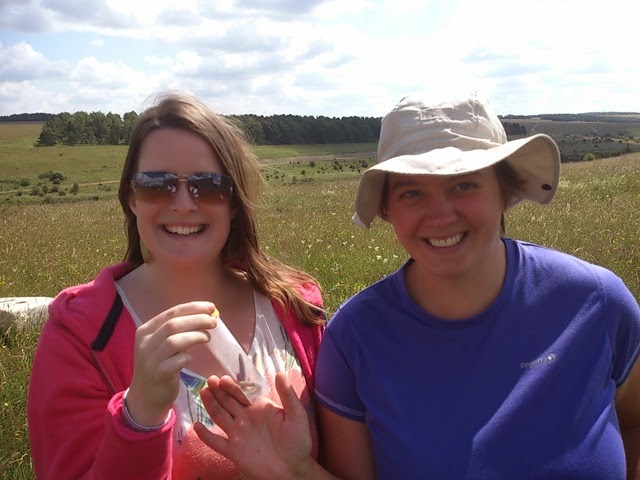
Vicky and I with earthworm on Salisbury Plain
Vicky and I with the first earthworm of the day, probably Apporectodea longa, found under a rusty drum
Being a chalk download there were many woodlice and molluscs to be found under the stones, including the pill woodlouse Armadillidium vulgare, a species familiar to many for its defense of rolling up into a ball. Many of the specimens had babies, which develop from eggs in a special brood pouch on their underside.

Armadillidium vulgare with young from Salisbury Plain
Armadillidium vulgare with young on Salisbury Plain
Flowers and insects were everywhere, more than I have seen anywhere, and I get the feeling other chalk grasslands will never look so good again! Lepidoptera were everywhere, this thistle busy with Marbled Whites (Melanargia galathea), Burnet moths (Zygaena sp.) and assorted flies was typical. Other day-flying moths seen included the striking Forester (Adscita statices). I also saw some impressive flies including Cynomya mortuorum, my old favourite previously seen in Scotland, and the huge black parasitoid fly Tachina grossa.

Insects nectaring on thistle on Salisbury Plain
Marbled Whites, Burnet moths and assorted flies nectaring on thistle

Forester on Greater Knapweed at Salisbury Plain
I met a number of new plants, including Dwarf Spurge (Euphorbia exigua), the rare Tuberous Thistle (Cirsium tuberosum) and probably my most exciting plant of the day, Knapweed Broomrape (Orobanche elatior), a plant parasitic on Greater Knapweed (Centaurea scabiosa).


Knapweed Broomrape (Orobanche elatior) on Salisbury Plain
Knapweed Broomrape (Orobanche elatior) on Salisbury Plain
My most exciting invertebrate of the day was neither a fly nor an earthworm however, it was the Fairy Shrimp (Chirocephalus diaphanus) which I have wanted to see since I first learnt about it when I was around 5 years old. These shrimp are found in temporary pools, their eggs lying dormant when the pools dry out ready to hatch on the next heavy rain. It is protected under Schedule 5 of the Wildlife and Countryside Act 1981 but the trip organisers, who have a licence, had collected some in a jar for us to view.

BRC 50th delegates huddle around temporary pools created by military vehicle manoeuvres to look for the elusive Fairy Shrimp
Fairy Shrimp
Fairy Shrimp (Chirocephalus diaphanus)
The photograph through the container using my phone really does not do them justice. They were quite big, a couple of inches long with a translucent pinkish colour, swimming using beautiful undulating motions.

So in all it was a brilliant weekend, meeting new species (and people!) and giving me lots to think about for my own research. A big thanks to the organisers, and long may the BRC continue.

Thursday, 12 December 2013

More earthworm sampling, or the mystery of the farty mustard


Another county, another field… Last Monday and Tuesday I was again away with the Natural History Museum Soil Biodiversity Group, this time heading up to Leicestershire, for more earthworm sampling. Not as scenic as Somerset, we were sampling in a research farm near Loddington, in addition to myself, Sholto was again volunteering, I also met for the first time Salma and we were joined by Irfaan on Tuesday.
Image00003
Another earthworm is sampled by Irfaan, with Salma and Sholto
tape
Salma is trained in the correct way to retract the tape measure

In the previous week there was a problem with the mustard solution, which had developed a pungent smell of hydrogen sulphide (egg-fart gas). This was a concern because the smell was so strong it could be killing the worms in their burrows before they could emerge. Could the change be because of a faulty batch of mustard powder, or change to the ingredients? This week different batch numbers of mustard powder were purchased to test this.
Image00004
David checks the bouquet of the mustard solution

Sniffing the mustard solution before pouring was now a necessary step, after the first mixing the smell was promising but by the morning some bottles had deteriorated. A new hypothesis was proposed that some sort of bacterial contamination was causing the smell and then it was realised the problem started after the mustard solution was made up using water from the soil laboratory back at the the Museum. The water in the labs comes from the museum’s own borehole and often has a slightly sulphurous smell, could some sulphur-reducing bacteria dwelling in the supply have caused the problem? It was decided to use fresh water bottles on the next trip.

Tuesday evening we travelled back to London and on Wednesday I spent the afternoon helping in the soil laboratory preparing the kit for Thursday and Friday and changing the alcohol in the earthworm samples. Earthworms have a high water content and this dilutes the alcohol, if the liquid is not replaced with fresh spirit the earthworms can start  to decompose which makes identification difficult (and stinky). Then Wednesday evening we left for Dorset - the final county being sampled in.

Soil Biodiversity Group earthworm samples
That’s a lot of earthworms!

Living in just the next county I have had many family holidays in Dorset and it was a pleasure to be back in beautiful Purbeck. Our site was near a quarry were limestone (Purbeck ‘marble’) is extracted and on Friday we got to view a blasting, which was very exciting.

Quarry manager Simon discusses the site with David
Quarry blasting (guess who made the excited squeal!)

The shallow soil did not yield many big anecic worms but large numbers of smaller species, since earthworms have a preference for areas of high pH. As might be expected there were also large numbers of snail shells which I tried my best not to be distracted by, although I think I may sneak a few specimens when we return next week!
The Soil Biodiversity Group at the end of a hard day's earthworm sampling
Off for a well-earned meal after a hard day’s earthworm sampling

Monday, 7 October 2013

Chasing flies in Scotland


Between handing in my MSc thesis and my viva voce, I was fortunate enough to have the opportunity to join Dipterists from the Natural History Museum on a collection trip to Scotland as part of the Dipterists Forum Autumn Field Meeting. Despite the daunting prospect of a long journey and sharing a cottage with people I barely knew I couldn’t pass up the opportunity for an intensive week studying flies which was also my first trip across the border.
I had a fantastic time, proving to me yet again that no matter how scary something seems it is always worth doing it anyway. I even had the honour of writing up the trip for Erica McAlister’s Curator of Diptera’s Blog, so rather than blog the trip here is
Field trips through the eyes of innocents….

Dipterists under the (double) rainbow, Knappach Cottage, Kingussie
IMG_2128

Saturday, 10 August 2013

Balcony beasties – cabbage whites and their enemies


It is true you do not have to go far to see wildlife, even in the midst of a big city. Invertebrate scholars are particularly fortunate in this regard as insects, arachnids etc. really are everywhere, in your home and even on you. Here in my student room in Earls Court, London I have a little balcony which I have used to grow salad and tomatoes. Being an entomologist I soon became more interested in the creatures eating my vegetables (and eating them!) than the produce.

I watched a large white (Pieris brassicae) lay clusters of eggs on my kale a couple of weeks ago. Now if i was a ‘proper’ gardener I would remove these but as an entomologist I take pleasure in watching them develop so don’t begrudge them my salad. The caterpillars hatched and grew rapidly, first feeding together then spreading out on the container of plants. I later found a single small white (Pieris rapae) caterpillar which I had missed, as these are laid singly and must have been overlooked.

Large White caterpillars feeding on my kale on the balcony
cats
Small White caterpillar (note the leaf mines on the kale, I will discuss these in another post)
small white
By early August they were ready to pupate but I have only found on successful pupae, the rest being devoured inside out by the braconid wasp Cotesia glomerata.

The only successful large white pupa
large white pupa
All but one of the infected caterpillars mostly moved away from the food plant, climbing up the balcony to find a place to pupate, instead the braconid larvae emerged from the caterpillars and spun silk cocoons, the moribund caterpillar remaining attached and hunched over the cocoons. The caterpillars were still alive for sometime after the parasitoid larvae had emerged and pupated.

Cotesia glomerata larvae emerging from large white caterpillar, this one remained on the food plant.
IMG_1920
Caterpillar on the side of the balcony with Cotesia glomerata in their silk cocoons underneath.
IMG_1904
The small white caterpillar had a different fate, though no less gruesome. I woke up one morning to find it being macerated and carried of piecemeal by a wasp. Amongst the remains it could be seen it was also infested by Cotesia glomerata larvae.

wasp dinner
The next balcony bugs post will focus on the flies in my vegetable garden.