| Hundreds of termites sorted from a Soil Biodiversity Group litter sample |
![]() |
| Scorpions and a pretty fly from Borneo leaf litter samples |
| Hundreds of termites sorted from a Soil Biodiversity Group litter sample |
![]() |
| Scorpions and a pretty fly from Borneo leaf litter samples |
I recently took a day off volunteer on fieldwork with the Natural History Museum Soil Biodiversity Group – my first fieldwork with the group since the BESS Earthworm Project, and a nice change from the pollinator and plant surveys I have been doing as part of my work at Reading University. The project I assisted on this time is the National Vegetation Classification (NVC) Project, this is a structured survey of soil and litter invertebrates across UK woodland types which began in 2002 and is now on its third round of sampling. The National Vegetation Classification categorises all UK ecosystems according to major vegetation type (woodland, grasslands etc.) which are then broken down into community types according to plant species composition. Woodlands are given the prefix W and fall into ‘wet woodland’ W1 to W7 and ‘dry woodland’ W8 to W18, this year is the turn of the dry woodlands and the study site I visited was Warburg Nature Reserve in Oxfordshire, an example of W12, a beech (Fagus sylvatica) woodland with plants characteristic of basic soils such as Dog’s Mercury (Mercurialis perennis).
Quadrat assembled – sampling can begin!
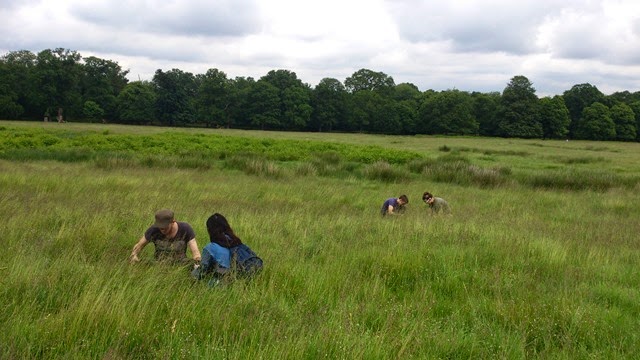
Instead of sampling from random quadrats as in my MSc fieldwork the NVC project uses a transect through the habitat with a 1m square quadrat being sampled at set intervals, alternating each side of the transect line. Other than that the method was similar, fellow volunteer and current MSc student Dan and I took turns scrapping and sieving litter from the quadrat which was then bagged up with a label to take back to the lab. Paul took the environmental readings while Kelly dug a soil pit and collected any invertebrates found into tubes of alcohol. A vegetation survey was also made of each quadrant, although being a beech woodland this was sparse and a lot less effort than my MSc project were the quadrats were often covered in vegetation!
Dan sieves leaf litter while Kelly sorts soil for invertebrates
After the cold wet days sampling in the middle of winter for the BESS Earthworm work the NVC fieldwork on a sunny day was quite a treat, finishing before lunch! Then it was back off to the Natural History Museum to process the leaf litter samples. The sieved leaf litter is placed into mesh bags which are hung inside a Winkler bag, basically a cloth funnel with a pot of alcohol tied to the bottom. These are hung up for three days and as the leaf litter dries the invertebrates move downwards into the pot where they are preserved ready for sorting and identification. Once, the Winkler bags were hung up in one of the towers either side of the main entrance of the Museum, but now they are in a much more convenient location which doesn’t involve carrying bags of leaf litter up narrow Victorian staircases!
Paul puts the sieved leaf litter samples into Winkler bags
After the three days are up the pots can be removed ready to be sorted and counted to order level by volunteers with selected invertebrate groups later identified to species level. The NVC dataset is just one example of long-term data collection by the NHM Soil Biodiversity Group, another being the monthly sampling at Whitley Wood in the New Forest, which I am volunteering on in August. I am very excited to be given the opportunity to analyse these datasets, among others, in my upcoming PhD.
| Saturday morning in Bath |
![]() |
| The cake was tasty too! |
| Keiron and Vicky from the ESB make do with turning over stones to find earthworms on Salisbury Plain |
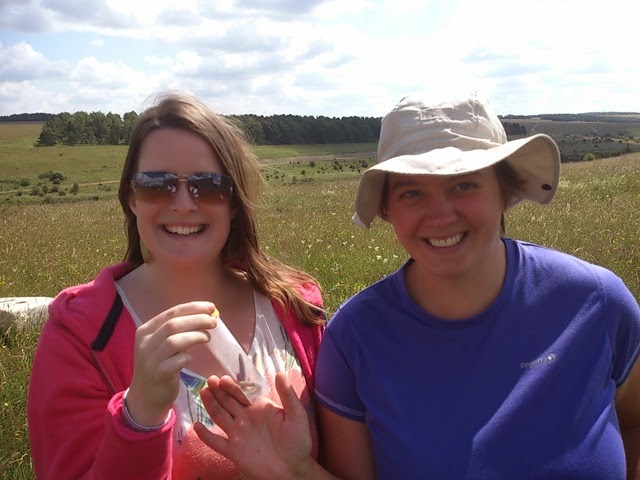
| Vicky and I with the first earthworm of the day, probably Apporectodea longa, found under a rusty drum |
| Armadillidium vulgare with young on Salisbury Plain |
| Marbled Whites, Burnet moths and assorted flies nectaring on thistle |
| Forester on Greater Knapweed at Salisbury Plain |
![]() |
| Knapweed Broomrape (Orobanche elatior) on Salisbury Plain |
![]() |
| BRC 50th delegates huddle around temporary pools created by military vehicle manoeuvres to look for the elusive Fairy Shrimp |
| Fairy Shrimp (Chirocephalus diaphanus) |
Last week I finished sorting and identifying ‘my’ half of the Soil Biodiversity Group’s samples from the BESS Earthworm Project. The tubes from the last couple of fields were rather full, and because earthworms contain a high percentage of water this had diluted the alcohol, reducing its preserving qualities. The liquid in the samples was dark and pungent and the earthworms soft, this made identification more difficult as the features can be obscured and the earthworms fragile to manipulate. The final earthworm I identified from the samples was a somewhat underwhelming, squishy, headless and tailless Aporrectodea longa!
The final tube was a particularly ‘squishy’ sample
Some previous samples were more exciting however, in particular during the project I have identified by first ever Ap. limicola, Ap. caliginosa subsp. noctura and Octolasion tyrtaeum, although sadly I did not meet the Ap. icterica I was also hoping to find. Here are some of the facts and figures from my time volunteering on the BESS earthworm project:
Sorting and identifying earthworms from 14 fields from seven farms took around 90 hours, and I counted a total of 5940 earthworm specimens, 2124 which could be identified to species. I identified 16 earthworm taxa in total, with the highest number (12) occurring at the Dorset site. This was also the site with the highest number of earthworms per single pit – a whopping 110 individuals, but the highest number of species per pit was from the Dumfries and Galloway site, with seven.
The most common species in my samples were, as expected, Aporrectodea caliginosa (742) and Allolobophora chlorotica (506), but the sites differed in abundance between the two and it will be interesting to see if any environmental preferences emerge when the whole dataset in analysed. The rarest earthworms in my half of the data are Ap. caliginosa subsp. nocturna and
Subjectively each field and farm had a different ‘character’ of earthworm diversity, and I am particularly looking forward to seeing what the statistics have to say about the variation between and within the different sites. Some preferences are quite obvious, Ap. limicola was found in large quantities exclusively (so far at least) from a field on a floodplain, and is known to have a preference for wet conditions (as suggested by its name, limnic = referring to freshwater). An old favourite of mine from my MSc project, Murchieona muldali, previously associated with hedgerows and field edges did seem to occur more frequently in low intensity fields with some scrub. There are so many other questions about earthworm diversity that the project will go some way to answering, like does earthworm diversity decrease with latitude? What are the environmental tolerances of each species and is there evidence for competitive exclusion? Do more fertile pastures have more individuals but fewer species? I am so excited to see the results!
I've been neglecting my blog again, tsh! There has been lots of exciting news in my life lately, but this has also accompanied by stress, and with so much on my mind I have not had the will to write.
Firstly I had the fantastic news that I was offered a place on the PhD I was interviewed for as the first choice candidate declined in favour of another offer. I accepted with little hesitation! The project title is Statistical modelling of how soil biodiversity and ecosystem function respond to human impacts in UK ecosystems, hosted at the Imperial College London Grantham Institute for Climate Change and working with the research groups PREDICTS and Soil Biodiversity Group at the Natural History Museum. This will use the huge unpublished datasets from the SBG to model how soil invertebrates respond to human impacts including climate change but there will be also be opportunities to collect new data - which will hopefully include some soil diptera larvae studies!
Secondly I accepted a job offer at Reading University which I began nearly a month ago. This is working as a field assistant at CAER with PhD student Chloe Hardman. She is researching biodiversity on farms using different agro-environment schemes, were farmers are paid for various activities which are supposed to increase biodiversity. Specifically I am helping with research on pollen and nectar sources on farms (i.e. flowers!) and pollinators. This involves fieldwork walking transects in different habitats across 12 farms in Southern England, recording bees, hoverflies and plants. It is wonderful to be making a living doing fieldwork identification skills after years of working inside an office! Together with my PhD offer I still can't quite believe how well my academic life is going at the moment, and keep thinking I will wake up from a dream!
My working conditions have improved greatly!
This Wednesday was my MSc graduation ceremony, I felt a little decadent going to another after my BSc one but the venue was the Royal Albert Hall in London so I couldn't pass up an opportunity to go there. My parents attended too so we decided to make a day of it, using the complimentary tickets I receive from volunteering at the Natural History Museum to visit the butterfly exhibition. It was fortuitous that the same day Paul was giving a Nature Live talk on the NERC BESS earthworm project which I have been volunteering on, which I dragged my parents along to see. Today I finished 'my' half of the samples and just in time as I will soon be returning to my MSc study site on the Isle of Wight to carry out more research there.
It’s going to be busy summer (indeed a busy four years are ahead!)
My motivations for joining the Listserve were part of my drive to communicate more with 'the world' and coincided with starting a blog (Science on the Spectrum) were I aim to discuss my scientific career aspirations through the lens of autistic spectrum disorder (ASD). I was diagnosed with Asperger Syndrome in 2012, a 'higher functioning' form of autism. This affects how a person makes sense of the world, processes information and relates to other people but because I am intelligent and outwardly appear capable, these disabilities are largely hidden. I have difficulty with the subtleties in verbal communication, such as understanding facial expressions and voice tone and knowing what people are thinking, explaining the problems I have experienced in interacting with others throughout my life. It is not all disadvantageous though, my condition is also associated with obsessive interests, a high attention to detail and love of pattern recognition which are valuable attributes for a career in science. It is therefore no surprise that those 'on the spectrum' are overrepresented in STEM (science, technology, engineering and mathematics) and that I should be drawn to this career from an early age.
It is not until recently that ASD has received more awareness and it was the opening of a clinic in my local area that prompted me to consider being officially diagnosed. It was not a decision I took lightly, as I was unsure whether having a 'label' would be a help or hindrance from a personal and career perspective. However I was applying for a full time Master of Science degree which would necessitate moving to London and having to live independently rather than rely on my parents' care and a diagnosis would give me access to support. I researched the experiences of others and discussed it with my family and General Practitioner/family doctor before deciding it was worth pursuing.
Since my diagnosis my attitude to my difficulties has changed, instead of constantly feeling inadequate for my social failings, for example when I attend a conference but am too scared to talk to many people it instead feels an achievement to have gone at all. Rather than a burden, I see my difficulties as a challenge to overcome and to that end decided to stop letting the fear of other people hold me back and 'feel scared but do it anyway'. With support from my family and the university's disability team, last year I achieved my ambition to gain a Master of Science studying at the Natural History Museum in London where I have continued to volunteer on a research project on earthworms - but that is another story!
I would be interested to hear the experiences of other STEM workers with autistic spectrum or other communication disorders.